Single Tooth Dental Implant in Turlock
Replacing one missing tooth without preparing the teeth beside it, planned from a 3D scan.
Medically reviewed by Dr. Broneil Ishaya, DDS — Fellow, Misch Resnik Institute of Implantology · California dental license #105491 · Oct 2026 · Written by the Turlock Dental Studio team
In short: A single tooth dental implant replaces one missing tooth with a titanium post seated in the jawbone, an abutment and a custom crown. Because the implant is self-supporting, the teeth on either side are not prepared or used as anchors the way they would be for a conventional bridge. Plan on several months for osseointegration before the final crown is fitted, with your own timeline set by the exam and scan.
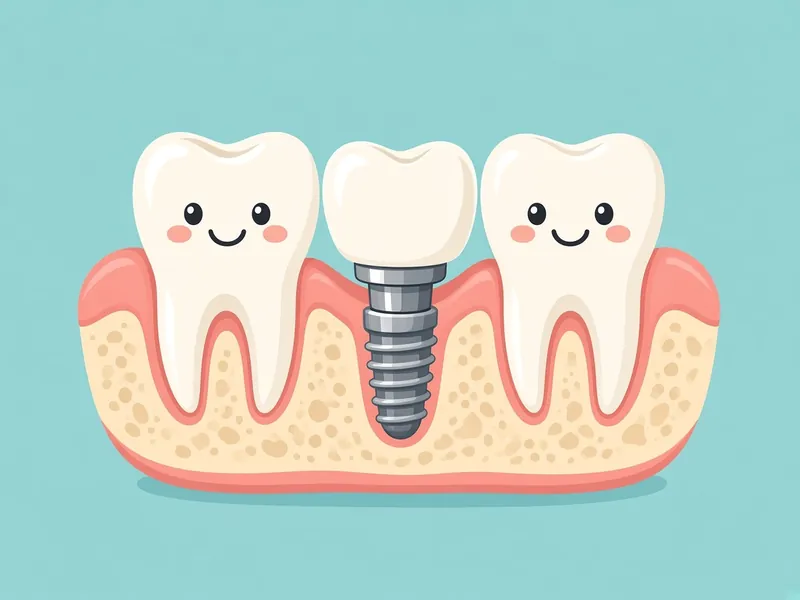
What a single tooth implant is and how it works
A single tooth dental implant restores one missing tooth in three parts. The implant is a threaded post, usually titanium, seated in the jaw where the natural root once sat; the abutment is the connector that emerges through the gum; the crown is the tooth-colored restoration built to match its neighbors.
The implant holds through osseointegration — bone growing into the microscopic surface of the post and locking it in place. That biology sets the schedule: the site is left undisturbed for months so the interface can consolidate before it carries a crown.
Replacing one tooth is as much a soft-tissue problem as a bone problem. The gum contour and the papilla (the small triangle of tissue between adjacent teeth) decide whether the result reads as a natural tooth, which is why the planning scan and the provisional matter as much as the surgery.
Who a single tooth dental implant is for
The typical candidate is an adult who has lost a tooth to decay, fracture or trauma, or is about to lose one and would rather not commit to a bridge. The factors that shape the decision:
- Bone volume at the site — the height and width of the jawbone available to house the implant. Where it is insufficient, bone grafting for dental implants can usually rebuild it.
- Keratinized tissue — the firm, attached gum around the implant neck, which helps seal the site and makes cleaning tolerable.
- Gum health. Active periodontal disease is treated before an implant is placed.
- Medical control. Uncontrolled diabetes, heavy smoking and some medications impair healing and revise the plan; they seldom rule implants out.
How treatment proceeds at our Turlock office
- Consultation and imaging. A 3D cone beam CT (CBCT) scan — a low-dose three-dimensional radiograph of the jaw — an iTero digital scan and a clinical exam. The CBCT shows bone volume, bone density, the nerve canal and the roots of the adjacent teeth.
- Written plan and itemized estimate. You see the proposed position, whether a graft is needed, the sequence and the estimate before anything is scheduled.
- Preparation, if needed. Extraction with socket preservation (graft material placed in the fresh socket to limit bone loss), or a graft to rebuild a site that has been empty for years.
- Implant placement under local anesthesia in our office, using a surgical guide where the plan calls for one.
- Osseointegration. An undisturbed healing interval, commonly several months. A provisional tooth is usually worn in the meantime.
- Abutment and crown. The gum is shaped, the abutment seated and the final crown fabricated and fitted.
- Maintenance. Regular professional checks and daily cleaning. Unlike a tooth, an implant has no periodontal ligament, so it does not defend itself against plaque in the same way.
Healing timeline and the first week
The surgical appointment for a single site usually runs about an hour. Swelling peaks on the second and third day; soreness is managed with the medication we prescribe, and a cold compress and a soft, cool diet help over the first day.
The gum closes over one to two weeks, then the interface consolidates over several months — the longest phase. Impressions and the final crown follow once the tissue is stable, with a provisional tooth in function throughout.
Avoid smoking during healing, and call us for bleeding that will not settle, pain worsening after day three, or fever. Our recovery and aftercare guidance covers the rest.
Alternatives worth weighing
- A traditional three-unit bridge avoids surgery, but requires grinding down the two healthy teeth beside the gap and is harder to clean underneath.
- A removable partial denture avoids surgery, is the least stable of the options, and comes out for cleaning.
- An implant-supported bridge is worth discussing when more than one tooth is missing in the same span. See our page on implant-supported bridges for several missing teeth.
Risks and limitations
Implant surgery is routine but not risk-free. Bleeding, bruising, swelling and discomfort are expected and settle. Infection, altered sensation near the mental nerve, failure to integrate and component fracture are less common and belong in an honest consent discussion. Longer term, peri-implant mucositis (reversible gum inflammation) and peri-implantitis (inflammation with bone loss) are the main threats, both strongly associated with smoking and skipped maintenance.
Esthetics are a genuine limitation at the front of the mouth: the gum will not always reproduce its original architecture, and a high smile line sometimes calls for grafting first. No surgeon can promise a specific outcome; the plan you receive is a recommendation, not a guarantee.
Guided implant surgery and 3D-planned dental implants
Planning starts before surgery. Dr. Ishaya takes a 3D cone beam CT (CBCT) scan in our Turlock office and uses it to map the bone, the nerves and the neighboring teeth, then designs the implant position in that 3D image. In suitable cases the plan is carried into the mouth with a surgical guide or guided drilling, so the implant is placed where the plan put it instead of where it looks right by eye.
Guided implant surgery is used when the case calls for it. When it fits, the practical advantages are greater accuracy and precision in placing the implant, often less invasive surgery, typically less post-operative discomfort and swelling, and results that follow a plan made before you sit down. It is not right for every case. The decision is case-dependent, and Dr. Ishaya makes it from your CBCT and exam, sometimes choosing a freehand approach where that suits you better.
A surgical guide improves control over implant position and angulation. It does not remove the risks of surgery and does not guarantee how an implant will heal.
Dental sedation for implant treatment
If anxiety, a strong gag reflex or the length of an implant appointment is what has kept you from treatment, we offer dental sedation for implant treatment in our Turlock office. Nitrous oxide, often called laughing gas, is breathed through a small mask and takes the edge off without putting you to sleep. It wears off quickly, so you can usually resume your normal day afterward.
Oral conscious sedation is a prescribed medication taken before the appointment. It suits patients who are more anxious or facing longer or more involved visits: you stay awake and able to respond, but deeply relaxed, and many people remember little of the appointment. Dr. Ishaya is licensed to provide both options, and you are monitored throughout.
Plan ahead for oral conscious sedation. You will need a ride home, and you should not drive or go back to work that day. Tell us about every medication and health condition at your consultation so we can choose the safest option for you.
Common questions
How long does a single tooth implant take from start to finish?
Most cases run several months, because the implant is left undisturbed while the bone consolidates around it before the crown is made. If grafting or an extraction is needed first, that adds time. Your own schedule is set at the consultation once the CBCT has been read.
Can I have a tooth on the implant the same day?
Sometimes a provisional crown can be placed at surgery, but it depends on how stable the implant is in the bone and on the bite. In many single-tooth cases it is kinder to let the site heal undisturbed first, and we will tell you which situation you are in before you commit.
Are dental implants at Turlock Dental Studio guided?
Yes, when your case calls for it. Dr. Ishaya plans implants from a 3D cone beam CT scan and, in suitable cases, uses guided implant surgery with a surgical guide or guided drilling so the implant is placed where the plan put it. Whether a guide is right for you is decided case by case after your CBCT and exam.
What credentials does Dr. Ishaya have?
Dr. Broneil Ishaya, DDS is a California-licensed dentist who holds a Fellowship in Implantology from the Misch Resnik Institute. He earned his dental degree at UC San Francisco and provides implant treatment at Turlock Dental Studio in Turlock, CA.
Is sedation available for implant treatment?
Yes. Nitrous oxide and oral conscious sedation are both available for implant treatment at our Turlock office, and Dr. Ishaya is licensed to provide them. Nitrous oxide is a light relaxation that wears off quickly, while oral conscious sedation is for more anxious patients or longer visits and requires a ride home afterward.
Whether this treatment is right for you can only be decided after an exam. Every case differs, and results vary.
Sources
Find out which option fits you, starting with a free consultation.
Book a free consultation